How Ancient Networks Redefine Human Wealth
An audio discussion and summary of The Wealth of Humanity: Together We Prosper.
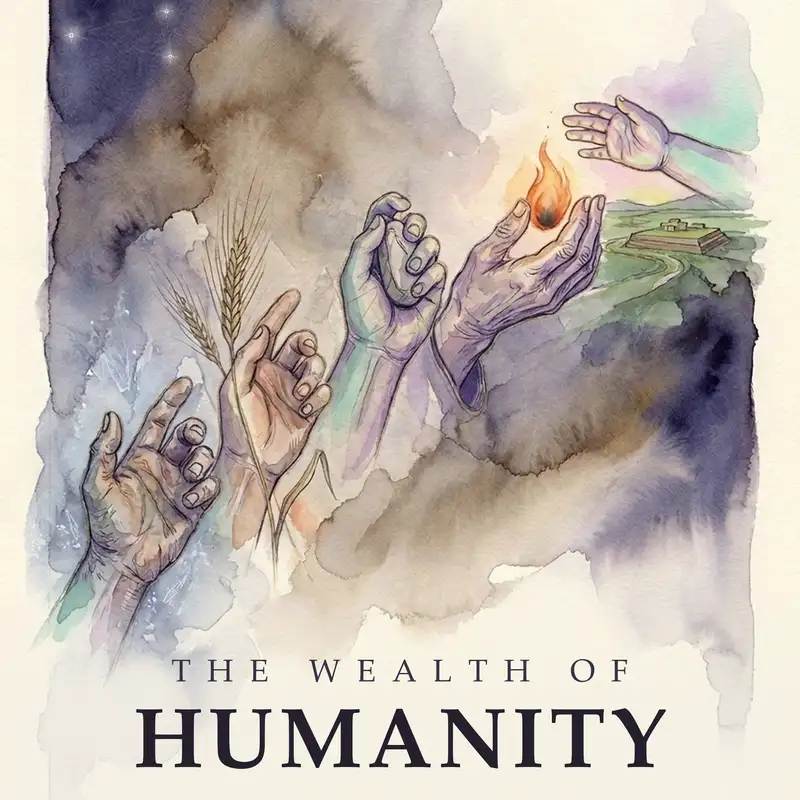
How did people survive the Ice Age with no metal, no writing and no farming? Not as lone hunters, but through networks of sharing. This episode follows that blueprint from the Kalahari to the Indus Valley, and asks what it means for how we measure wealth and plan communities today.
In this episode
- (00:00) Introduction by Mark Steven Hewitt
- (01:24) Surviving the ice together, not alone
- (03:40) Before metal: knowledge and fire as the first wealth, and the ratchet of cumulative culture
- (05:41) Ju/'hoansi hxaro gift partnerships, the Toba eruption, and what isolation did in Tasmania
- (09:04) Mehrgarh: early dentistry, shared granaries and a pebble count of the grain
- (10:46) The tragedy of the commons, Elinor Ostrom's answer, and the shamilat village commons of the Punjab
- (13:24) Mohenjo-daro and Harappa: cities without palaces, and the standard Indus weights as a system of trust
- (16:03) Adam Smith, GDP, and the five kinds of wealth: financial, ecological, cultural and human, social, generational
- (19:09) Start with what a community already has: asset mapping and the micro-city
- (21:25) The seventh-generation principle and a reserve held for the future
- (22:17) The raised platform: the test of anything we build is whether it outlasts us
- (23:47) Your own audit of the five kinds of wealth
If you share the fire, we all make it to spring.
About this episode: This is an AI-generated audio discussion: the two hosts are synthetic voices, and the introduction uses an AI clone of the author's voice (ElevenLabs). It was produced with Google NotebookLM from the book's manuscript. The Country Baseline Series it mentions is a set of research baselines, and the micro-city model and Regenerative Wealth Reserve are proposals set out in the book; they are not programs now operating in Pakistan.
Learn more about the book at nationsoflight.com.