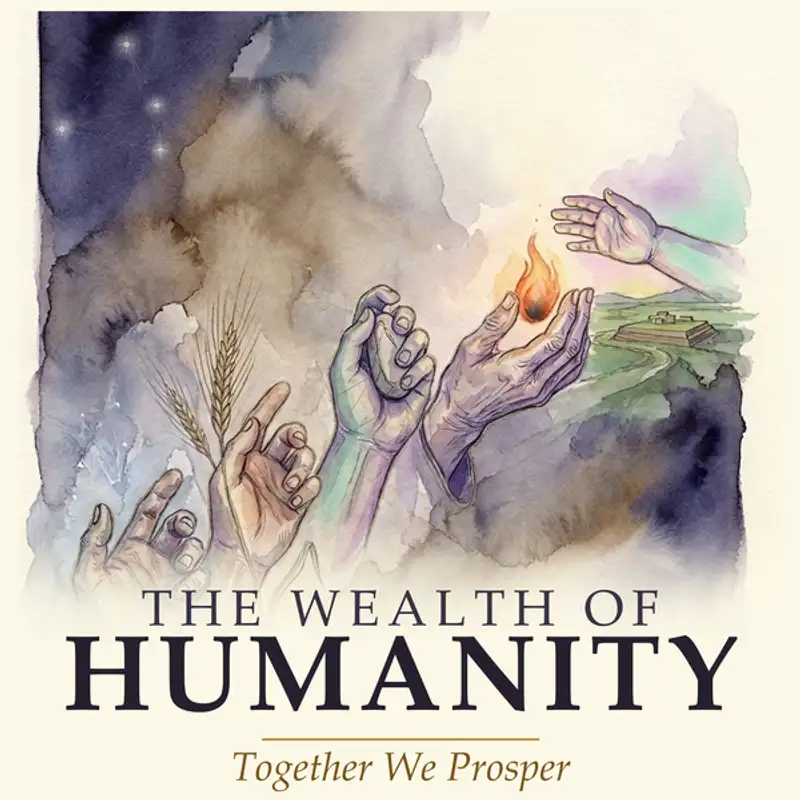
The Long Inheritance
When a modern climate disaster strikes, the immediate reality looks like this.
Supply chains snap, power grids fail, and communities are swallowed by water.
Compare that to the extremes our early ancestors faced.
During the Ice Age, humans survived thousands of years of howling winds and freezing temperatures.
Today, when our centralized systems start to buckle under pressure,
our instinct is often to retreat.
We stockpile resources, build higher walls, and try to prepare as isolated individuals or single households.
But the archaeological record paints a very clear picture of that strategy.
A single family trying to wait out a deep freeze alone inevitably runs out of food, fuel, or luck.
Going it alone is a guaranteed death sentence.
True climate adaptation means taking the ancient biological blueprint of shared resources that kept us alive
and upgrading it for the modern world.
This map shows the scale of the cold across South Asia during the last glacial maximum.
Ice sheets locked up millions of cubic kilometers of ocean water, creating a brutally dry and freezing environment.
Early humans endured this hostile planet without agriculture.
They had no metal tools to cut through the ice, and no written language to record the changing seasons.
Their most advanced survival tool was their social network.
Bands of early humans traveled vast distances to trade rare, high-quality stone
and to pass smoldering embers from one hearth to the next.
These exchanges created complex gift networks.
If a drought hit your specific valley, you could walk 100 miles to a neighboring camp and be taken in,
because two winters ago, you shared your surplus meat with them.
Critical knowledge, like where to find groundwater during a drought, functioned as a commons.
It was an environmental resource that actively kept the species alive,
specifically because it was shared among the group, rather than hoarded by an individual.
By the late 20th century, many economists assumed this kind of shared reliance was impossible in the modern world.
They popularized a theory called the tragedy of the commons,
arguing that if a resource is shared, selfish behavior will inevitably drain and destroy it.
Then, a political scientist named Elinor Ostrom began studying real-world communities.
She traveled to fisheries in Turkey and groundwater basins in California,
and she found that the economists' pessimistic assumption was entirely wrong.
Ostrom documented communities successfully managing their own resources for centuries.
She identified eight specific design principles they all shared,
including establishing clear physical boundaries for the resource
and ensuring that the people using it were the ones making the rules.
The tragedy is prevented by strict mechanics.
Someone locally monitors the resource, and if someone takes more than their fair share,
they fix graduated penalties that start small and grow larger,
backed by cheap, accessible conflict resolution.
Ostrom proved that community trust functions as a highly engineered, measurable system of local governance,
sustained by strict rules rather than simple goodwill.
Today, researchers in Pakistan are mapping out how to apply Ostrom's precise rules directly to future climate adaptation.
Under the proposed microcity model, a local community directly owns and governs its own connected systems of energy, water, and food,
completely bypassing the wait for distant national governments to build power plants or lay pipes.
A local solar microgrid operates on the exact same logic as that ancient shared campfire.
It is a vital resource maintained by the people who rely on it every day.
The shared hunting grounds of the Ice Age translate into modern community-managed aquifers
or a shared cold storage facility to keep a milk harvest from spoiling in the heat.
By keeping the infrastructure localized and the ownership close to home, these micro-cities strip away their dangerous reliance on imported fuels and fragile, distant supply chains.
The current global standard evaluates a nation's success almost entirely through gross domestic product.
But tracking financial metrics alone masks deep societal vulnerabilities.
This radar chart maps out a new framework.
True resilience requires calculating five distinct kinds of wealth at once.
Financial, ecological, cultural, social, and generational.
For example, if a farming community drains its underground aquifer to grow water-intensive cash crops,
its financial ledger shows a massive profit.
But the ecological and generational ledgers completely collapse, leaving the town structurally unstable.
Social wealth, the strength of local institutions and the bonds between neighbors,
acts as the foundational glue.
It is the only thing that allows a community to coordinate
and protect the other four resources during a crisis.
Future abundance requires balancing all five of these ledgers simultaneously.
You cannot build a durable society by sacrificing one to inflate another.
These decentralized systems gain true power when they link together.
Individual microcities can federate to share excess solar power across microgrids
or pool their money into disaster relief funds.
achieving massive scale without ever surrendering their local authority.
Just as ancient bands of humans survived by linking across treacherous valleys,
modern communities can link across borders, entirely bypassing centralized points of failure.
In the villages of the Indus Plain, when the river floods, families seek safety on raised earthen platforms.
No one living today knows who built them.
They are physical manifestations of generational wealth, constructed decades ago by ancestors to protect people they would never meet.
The ultimate task of climate adaptation is constructing that raised platform for those who come after us.
Together, we prosper.
Apart, we fail.
[Closing: Mark Steven Hewitt]
Thank you for listening to The Wealth of Humanity.
You can read the book free at nationsoflight.com, where you'll also find my other books. Follow the podcast wherever you listen, so you'll hear each new discussion as it's released. Episodes, notes and transcripts are at podcasts.nationsoflight.com.
And if something here gave you a reason to think, pass it on to someone who would want to hear it.